
INVESMENT ZONE | In an era defined by rapid geopolitical shifts and the unprecedented integration of artificial intelligence into global markets, the concept of a diversified investment portfolio has transitioned from a mere suggestion to an absolute necessity for survival. As we move through 2026, the traditional financial playbooks are being rewritten. Inflationary pressures in the West, coupled with the “de-dollarization” movements in the East, have created a landscape where single-asset reliance is a recipe for disaster. Whether you are a retail investor in Jakarta or a fund manager in London, the goal remains the same: protecting capital while capturing the growth of a changing world.
The volatility observed in the past few years has taught the international community a harsh lesson: markets do not move in isolation. A tremor in the tech sector of Silicon Valley can cause ripples in the commodity markets of Australia within seconds. Therefore, understanding how to balance traditional safe havens like gold with growth-oriented assets like stocks and professionally managed mutual funds is the key to maintaining a Strong Portfolio that can withstand the storms of the mid-2020s.
The Modern Imperative: Why Diversification is the Ultimate Hedge
Diversification is often described as the only “free lunch” in finance. By spreading your capital across various asset classes that do not move in perfect correlation, you effectively reduce the specific risk of your portfolio without necessarily sacrificing long-term returns. In the current global climate, where supply chain disruptions and energy transitions are frequent, the correlation between assets has become more complex.
A diversified investment portfolio acts as a shock absorber. When equity markets face a “black swan” event—such as a sudden regulatory crackdown on AI or a regional conflict—the presence of non-correlated assets like gold or fixed-income mutual funds prevents the entire portfolio from collapsing. As legendary investor Ray Dalio has frequently emphasized, the “holy grail” of investing is finding fifteen to twenty uncorrelated return streams.
Gold: The Eternal Anchor in a Digital Age
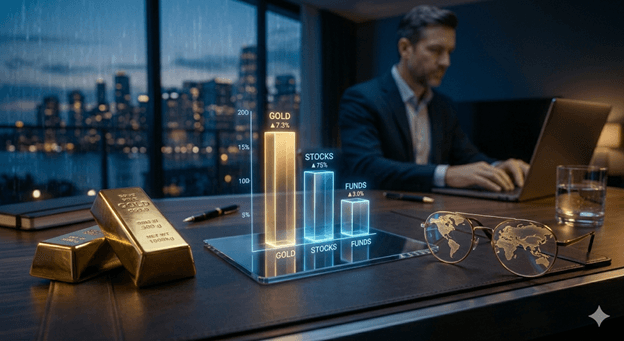
While 2026 is dominated by digital assets and algorithmic trading, gold remains the ultimate store of value. Historically, gold has a low to negative correlation with stocks and bonds, making it the perfect stabilizer. In the current international context, central banks—particularly in the BRICS+ nations—have been accumulating gold at record levels to hedge against currency debasement and sanctions.
Why Gold Matters Now:
- Inflation Hedge: Despite various monetary policies, gold maintains purchasing power over the long term.
- Geopolitical Insurance: During times of war or international tension, “flight to safety” almost always leads back to bullion.
- Liquidity: Gold is one of the few assets that can be liquidated instantly in nearly any currency in the world.
For the modern investor, “diversifying with gold” does not necessarily mean hiding bars under a mattress. The rise of Gold ETFs (Exchange-Traded Funds) and digital gold platforms has made it possible to own fractional shares of audited, physical gold with the click of a button, providing both the security of the metal and the convenience of modern FinTech.
Navigating the 2026 Stock Market: Beyond Big Tech
The equity portion of a diversified investment portfolio in 2026 looks significantly different than it did five years ago. We are currently witnessing a “Great Rotation.” While the “Magnificent Seven” tech giants still hold sway, smart money is moving toward sectors that underpin the new global economy: green energy, semiconductors, and automated manufacturing.
Strategic Stock Selection:
- Blue-Chip Stability: Investors are returning to companies with strong “moats” and consistent dividends, especially as the era of “easy money” and zero-interest rates remains a distant memory.
- The Green Frontier: As international climate accords reach critical deadlines, companies specializing in carbon capture, hydrogen power, and sustainable agriculture are becoming core holdings for growth.
- Emerging Markets: With the shifting center of gravity toward the Global South, exposure to stocks in India, Southeast Asia, and parts of Africa offers a growth trajectory that more mature markets may no longer provide.
To calculate the expected return of a stock within your portfolio, professionals often use the Capital Asset Pricing Model (CAPM):

Where E(Ri) is the expected return, Rf is the risk-free rate, beta_i is the asset’s sensitivity to market movements, and E(Rm) is the expected market return. Understanding these metrics allows an investor to balance high-volatility “growth” stocks with low-beta “value” stocks.
Mutual Funds and ETFs: The Power of Collective Intelligence
For those who do not have the time to track every fluctuation in the Hang Seng or the NASDAQ, mutual funds and ETFs are the essential vehicle for a diversified investment portfolio. These instruments allow investors to pool their resources, granting them access to a professional fund manager’s expertise and a broad range of assets that would be too expensive to buy individually.
The Role of Passive vs. Active Management
In 2026, the debate between passive and active management has reached a middle ground. While low-cost index funds remain the backbone of most retirement accounts, “active ETFs”—which use AI-driven algorithms to rebalance based on real-time economic data—are gaining traction. These funds can pivot quickly during market reversals, offering a layer of protection that traditional “static” funds cannot.
Strategic Asset Allocation: The 60/40 Rule Revitalized
For decades, the 60% stocks and 40% bonds split was the gold standard. However, the 2026 market demands more nuance. Many experts now suggest a “Multi-Asset” approach, which might look like this:
- 40% Equities: A mix of global blue-chips and thematic growth (AI, Green Energy).
- 30% Fixed Income/Mutual Funds: Targeting high-yield corporate bonds or diversified debt funds.
- 15% Commodities (Gold/Silver): To act as a hedge against systemic failure.
- 10% Cash/Cash Equivalents: To provide liquidity for “buying the dip.”
- 5% Alternative Assets: Including REITs (Real Estate Investment Trusts) or a small exposure to established cryptocurrencies.
Risk Management: Protecting Your Gains
A diversified investment portfolio is only as strong as its risk management strategy. In a world of high-frequency trading, “flash crashes” are a real possibility. Investors must utilize tools such as:
- Stop-Loss Orders: Automatically selling an asset when it hits a certain price to prevent further losses.
- Rebalancing: At least twice a year, investors should sell assets that have performed exceptionally well and buy those that are undervalued to maintain their target allocation.
- Dollar-Cost Averaging (DCA): Investing a fixed amount regularly, regardless of price, to smooth out the impact of volatility.
The Path to Financial Sovereignty
The world of 2026 is one of great opportunity but also significant peril. The shift from a unipolar to a multipolar world order means that the “safe” investments of yesterday may not be the safe investments of tomorrow. By building a diversified investment portfolio that balances the timeless security of gold, the growth potential of global stocks, and the professional oversight of mutual funds, you are doing more than just saving money—anda sedang membangun kedaulatan finansial (you are building financial sovereignty).
The most successful investors in this decade will not be those who find the next “unicorn” stock, but those who build a resilient, adaptable structure for their wealth. Markets will fluctuate, currencies will rise and fall, and technologies will disrupt entire industries, but a well-diversified strategy remains the ultimate compass in the global financial wilderness.