


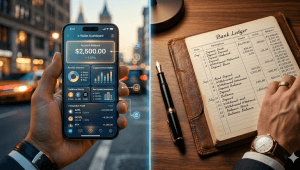
FINANCE ZONE | The evolution of financial technology has ignited a global debate: is an e-wallet superior to a traditional bank account in terms of security and efficiency? As the world moves rapidly toward a cashless economy, understanding the nuances between these two financial pillars is essential for any modern consumer. While traditional banks have served as the bedrock of global financial stability for centuries, digital wallets are redefining how we interact with money on a daily basis.
The Rise of Digital Wallets in a Global Context
In major financial hubs from London to Singapore, the e-wallet has moved beyond a simple convenience tool to a necessity. Whether it is Apple Pay, Google Wallet, or region-specific giants like Alipay or Venmo, these platforms integrate seamlessly into the user’s mobile ecosystem. Unlike traditional banks, which were designed around physical branches and bureaucratic processes, digital wallets are built on the principles of high-speed connectivity and user-centric design.
For the modern traveler or the digitally native professional, the ability to store multiple payment methods, loyalty cards, and even digital identification in a single, secure application is a game-changer. But as we embrace this convenience, we must look closer at the safety mechanisms that underpin these platforms.
Security: The Tug-of-War Between Legacy and Innovation
One of the primary concerns for users is the safety of their assets. Traditional banks pride themselves on decades of regulatory oversight, deposit insurance schemes (like the FDIC in the U.S. or the FSCS in the UK), and robust, albeit sometimes sluggish, fraud detection systems.
Conversely, digital wallets offer a different kind of security. Many modern apps utilize:
-
Tokenization: This hides the user’s actual card numbers, replacing them with unique digital codes during transactions. Even if a merchant is hacked, the user’s data remains shielded.
-
Biometric Authentication: Face ID and fingerprint scanning provide a layer of physical security that a lost credit card simply cannot match.
-
Real-time Notifications: Instant alerts allow users to flag unauthorized transactions immediately, often before the merchant has even processed the payment.
However, the risk shifts toward digital threats. While physical theft of a bank card is a traditional concern, phishing, account takeovers, and malware are the new frontier for digital finance.
Efficiency: The Core Advantage of Digital Payments
When it comes to efficiency, the e-wallet is the clear winner for day-to-day transactions. The friction involved in traditional banking—logging into a web portal, authenticating a two-factor code, and waiting for transfers—is often bypassed by the “tap-and-go” culture of digital wallets.
For international transactions, the efficiency gap is even wider. Traditional bank wire transfers can take days and incur heavy fees. In contrast, many digital payment platforms offer near-instantaneous cross-border transfers. For the “global citizen” who operates across borders, this immediacy is no longer a luxury; it is a requirement.
The Convergence: Why You Don’t Have to Choose
The most successful financial strategy in 2026 is not to pick one over the other, but to leverage the strengths of both. Most savvy consumers now use a hybrid approach:
-
The Bank as the Vault: Use traditional banks to hold primary savings, investments, and larger deposits where deposit protection schemes provide the highest level of stability.
-
The E-Wallet as the Engine: Use digital wallets for daily spending, subscriptions, and rapid peer-to-peer transfers. By keeping only a limited amount of funds in the digital wallet, the risk of a potential security breach is effectively minimized.
The Future Landscape: AI and Decentralization
As we look toward the next decade, the integration of Artificial Intelligence (AI) will further narrow the divide. Banks are increasingly adopting AI to mirror the user experience of e-wallet platforms, while digital wallets are gaining banking licenses to offer more sophisticated financial services like high-yield interest accounts.
Furthermore, with the rise of Central Bank Digital Currencies (CBDCs) in various nations, the line between an “e-wallet” and a “bank account” may soon blur entirely. The future will likely see a unified digital interface that connects the security of central banking with the lightning-fast efficiency of digital fintech solutions.
Final Thoughts
The decision between an e-wallet and a traditional bank account is rarely binary. It is a spectrum of financial tools designed for different purposes. As global markets continue to evolve, staying informed and adopting a multi-layered approach to your finances will ensure that you remain both secure and efficient, regardless of where in the world you are managing your money. By embracing the best of both worlds, you position yourself to navigate the modern digital economy with confidence.